
For men with eczema or chronically sensitive skin, soap choice isn't a preference - it's a factor in how well the skin manages day to day. The wrong bar strips the skin's natural barrier repeatedly, triggering flares, dryness, and irritation. The right one cleans without disrupting what the skin is already struggling to maintain.
Here's what the research supports and what to look for.
What Eczema Actually Is
Eczema - atopic dermatitis - is a chronic condition characterized by a compromised skin barrier. The outermost layer of skin, the stratum corneum, doesn't retain moisture effectively and is more permeable to irritants and allergens than normal skin. The result is skin that dries out faster, reacts more readily, and takes longer to recover from disruption.
For men with eczema, daily washing is both necessary and a recurring source of barrier disruption. The goal is a cleanser that removes dirt and bacteria without further compromising the barrier - which is a different standard than what most soap is designed to meet.
Why Conventional Soap Makes Eczema Worse
Most conventional bars are built on synthetic detergents with a high pH - significantly more alkaline than the skin's natural range of 4.5 to 5.5. Alkaline cleansers disrupt the acid mantle, the thin protective layer that maintains barrier function. For normal skin, that disruption is temporary. For eczema-prone skin, which is already compromised, repeated alkaline exposure keeps the barrier in a state it can't fully recover from between washes.
Synthetic additives compound the problem. Artificial fragrances, preservatives like parabens, and colorants are among the most common contact irritants documented in dermatological research. Men with eczema are more susceptible to contact reactions than those with normal skin - the compromised barrier allows irritants to penetrate more readily.
What Natural Soap Does Differently
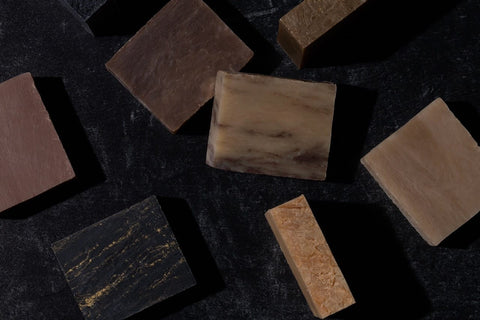
A cold process bar built on saponified plant oils has a pH closer to skin's natural range than most conventional alternatives. It doesn't eliminate the alkalinity inherent to soap - real soap is never fully pH-neutral - but it sits closer to where skin needs it to be.
The retained glycerin in a cold process bar is particularly relevant for eczema-prone skin. Glycerin is a humectant that draws moisture toward the skin and supports barrier function after washing. Commercial manufacturers extract it. Cold process bars keep it in. For skin that's already struggling to retain moisture, every wash with a glycerin-rich bar supports rather than depletes the barrier. What Is Glycerin in Soap — And Why Does It Matter?
Ingredients to Look for
Olive oil - high in oleic acid, which closely mirrors the skin's natural sebum. Gentle, deeply conditioning, and consistently well-tolerated by reactive skin types. A bar with significant olive oil content is one of the better starting points for eczema-prone skin.
Shea butter - documented anti-inflammatory properties and rich in fatty acids that support barrier repair. Well-suited for skin that's both dry and reactive. What Shea Butter Does for Your Skin — And Why It Belongs in Your Soap
Sunflower oil - high in linoleic acid, which has specific relevance for eczema-prone skin. Research suggests that eczema-prone skin tends to be deficient in linoleic acid, and topical application may help support barrier function.
Ingredients to Avoid
Heavy fragrance concentration - fragrance is one of the most common causes of contact dermatitis in people with reactive skin. For eczema-prone skin, a lightly scented bar is a safer choice than a heavily fragranced one. This applies to both essential oils and fragrance oils - some essential oils, particularly citrus, cinnamon, and clove, can be irritating at high concentrations. The issue is load, not source.
Parabens and synthetic preservatives - documented contact allergens for some skin types, and more likely to trigger reactions in skin with a compromised barrier.
Artificial colorants - FD&C and D&C dyes are among the more common contact irritants in personal care products. A bar with no added colorants is lower risk for reactive skin.
How to Test a New Bar
Introduce one product at a time. If you switch soap and experience a reaction, you want to know which variable caused it. Use the new bar for two to three weeks before drawing conclusions - some initial adjustment is normal.
Apply a moisturizer immediately after washing while skin is still slightly damp. For eczema-prone skin, the window between rinsing and moisturizing matters - moisture absorbed during the shower begins evaporating quickly, and sealing it in within a few minutes of patting dry significantly improves hydration outcomes. What Is a Natural Daily Moisturizer - And Do Men Actually Need One?
If your eczema is severe or persistent, a dermatologist's guidance on specific products is worth having alongside any changes to your routine.
The Bearsville Bars
Born in the Catskill Mountains, where the landscape is rugged, the air is fresh, and craftsmanship counts for something. Bearsville Soap Company has been at this for over a decade - cold process, small-batch, glycerin intact. One bar at a time, one customer at a time. No shortcuts, no fillers, no corners cut.
Our bars are built on saponified organic coconut, olive, sunflower, and shea butter oils - a formula well-suited for sensitive and reactive skin. No parabens, no synthetic detergents, no harsh additives. The glycerin stays in.
Once you go real, you never go back.