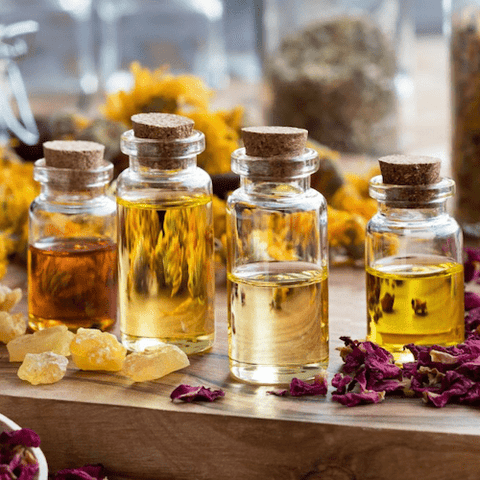

Essential oils and fragrance oils are the two main ways natural soap makers scent their bars. Both are legitimate. Both appear in well-made natural soap. Understanding the difference — and what each brings to a bar — helps you make sense of what you're actually buying.
What Essential Oils Are
An essential oil is a concentrated plant extract — the volatile aromatic compounds drawn from flowers, bark, leaves, roots, or rinds through distillation or cold pressing. The oil carries the characteristic scent of the plant it came from: peppermint oil smells like peppermint, eucalyptus oil smells like eucalyptus, cedarwood oil smells like cedar.
Essential oils are complex compounds. A single essential oil can contain dozens of individual aromatic molecules, which is why natural scents tend to have depth and movement — top notes that hit first, middle notes that develop, base notes that linger. That complexity is difficult to replicate synthetically, and it's part of what gives essential oil-scented products a distinctive character.
In soapmaking, essential oils are added at trace — the point in cold process soapmaking where the oils and lye mixture has emulsified. Some essential oils behave well in cold process soap and hold their scent through curing. Others — particularly citrus oils — are volatile enough that the scent fades significantly by the time the bar is ready to use. This is one reason citrus-scented soaps often use fragrance oils instead of or alongside essential oils.
What Fragrance Oils Are
Fragrance oils are lab-formulated scent compounds — blends of aromatic molecules designed to produce a specific scent profile. Some of those molecules are derived from natural sources. Others are synthetic. The distinction isn't inherently meaningful for quality or safety — what matters is how the fragrance oil is formulated and what it contains.
Well-formulated fragrance oils used in personal care products are typically free of phthalates and known irritants. On an ingredient label, they appear simply as "fragrance" — which is standard industry practice across natural and conventional soap alike, not a signal of lower quality.
Fragrance oils give soap makers access to a wider scent palette than essential oils alone allow. Scents that don't exist as essential oils — certain woods, resins, and complex blends — can only be achieved through fragrance oils. They also tend to be more stable through the cold process saponification reaction and hold their scent reliably through curing and use.
How Scent Works in Cold Process Soap
The saponification process is alkaline — lye raises the pH of the mixture significantly during soapmaking. Some aromatic compounds are sensitive to that alkalinity and break down or morph during the reaction. A fragrance that smells one way in the bottle may smell different in a finished bar.
Experienced soap makers test fragrance and essential oil behavior in cold process — checking for acceleration (the mixture thickening too fast to pour), ricing, separation, and scent stability. The oils that make it into a well-made bar have been vetted for how they behave in the process, not just how they smell.
This is part of the craft that doesn't show up on a label but shows up in a bar that smells like it's supposed to, from first use to last.
What This Means for the Bar in Your Hand
Whether a bar is scented with essential oils, fragrance oils, or a blend of both, the scent is a small fraction of the total formula. The base oils — coconut, olive, shea butter — make up the vast majority of the bar and determine how it performs on skin. Scent shapes the experience. It doesn't change the cleansing or conditioning properties of the soap.
A well-scented bar from a maker who understands both the craft and the chemistry is going to smell good, hold its scent through use, and not irritate skin. That's the standard worth holding — not whether the scent source is synthetic or botanical. Is Your Bar Soap Actually Natural?
How Bearsville Approaches Scent
Bearsville bars are scented with a combination of essential oils and fragrance oils depending on the bar. The scent profile drives the choice — some scents are achieved best with essential oils, others require fragrance oils to get the character right. In both cases, the fragrance is formulated without phthalates or harsh chemical additives.
The result is a bar that smells specific, not generic. Described accurately, not oversold.