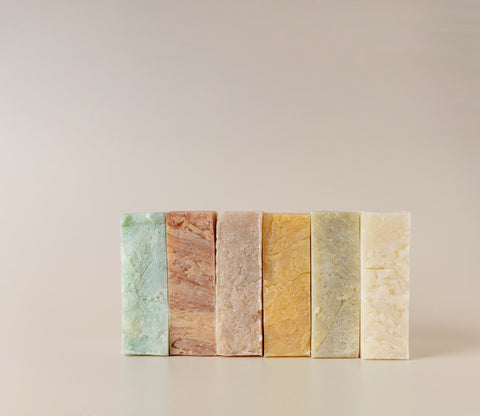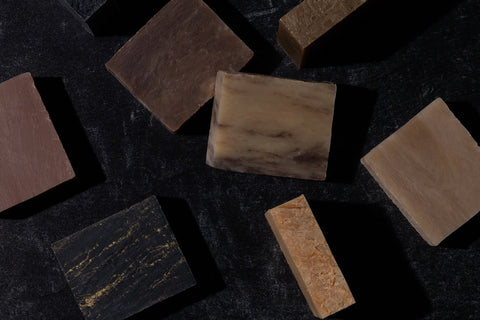

Handmade soap and commercial soap are both called soap, but they're made differently, from different materials, through different processes, with different results on your skin. The gap between them is wider than most people expect — and it starts before the bar ever reaches a shelf.
The Ingredients
Commercial soap is often not soap in the traditional sense. Many mass-market bars are synthetic detergent bars — built on compounds like sodium laureth sulfate or sodium cocoyl isethionate rather than saponified plant oils. These ingredients clean effectively, but through a different mechanism than real soap, and with a harsher effect on the skin's natural barrier.
Handmade soap starts with oils — coconut, olive, shea butter, castor, palm — and lye. The saponification reaction between those two things produces real soap. The ingredient list is short because the formula doesn't need much else. Is Your Bar Soap Actually Natural?
The Glycerin
This is where the practical difference shows up most clearly for most people.
Saponification produces glycerin as a natural byproduct. In handmade soap, that glycerin stays in the bar — where it acts as a humectant, drawing moisture toward the skin and helping it stay there after washing. It's why handmade soap leaves skin feeling clean without feeling tight or dry.
Commercial manufacturers extract that glycerin and sell it separately — it's a valuable ingredient in lotions, cosmetics, and pharmaceutical products. What remains is a bar that cleans but doesn't condition. The glycerin that would have balanced the cleansing effect is gone. What Is Glycerin in Soap?
The Process
Most handmade soap is made through cold process — oils and lye are combined at low temperatures, poured into molds, and left to cure for several weeks. No external heat is applied during saponification, which preserves the conditioning properties of the oils and the glycerin that forms during the reaction.
Commercial soap is typically made through a hot process method at industrial scale — faster, more efficient, and easier to control at volume. Heat accelerates saponification but also drives off some of the more delicate compounds that contribute to skin feel. The glycerin is extracted, synthetic additives are introduced for lather, preservation, and consistency, and the bar is finished and packaged within days rather than weeks. What Is Cold Process Soap?
The Additives
A commercial bar needs to survive mass production, long supply chains, and extended shelf time. That requires preservatives, synthetic stabilizers, artificial colorants, and fragrance compounds that hold up under those conditions.
A handmade bar made in small batches has a shorter shelf life by design — typically one to two years — and doesn't need preservatives to get there. The ingredient list stays short. What goes into the bar is what needs to be there for the soap to work, not what needs to be there for the bar to survive a distribution network.
What This Means in Practice
The difference isn't abstract. Skin that feels tight after showering, recurring dryness, or irritation from a bar that otherwise seems fine — these are often symptoms of a formula that's working against the skin's natural moisture barrier rather than supporting it.
Switching to a handmade bar built on saponified plant oils and retaining its natural glycerin tends to resolve these issues over a few weeks, as the skin adjusts to not being stripped with every wash.
It's not a dramatic transformation. It's just what happens when a bar is made from the right materials, the right way. Why Men Switch to Natural Soap and Don't Go Back
The Bearsville Bars
Bearsville bars are cold process, small-batch, and built on saponified organic oils. The glycerin stays in. The ingredient list is short. No synthetic detergents, no parabens, no unnecessary additives.