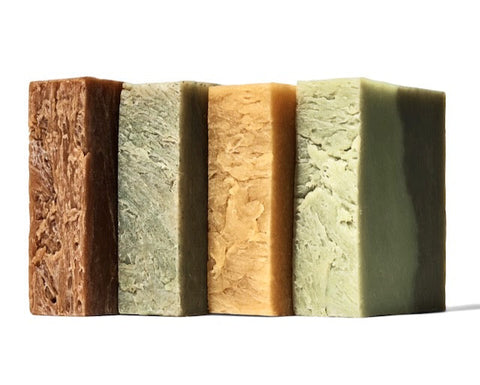

The textured, uneven surface on top of a Bearsville bar isn't a flaw in the manufacturing process. It's what a cold process bar looks like when it's made by hand, cut by hand, and not finished by machine.
Here's what's actually happening.
How Cold Process Soap Is Made
Cold process soap starts as a liquid. Oils and lye are combined, mixed until they emulsify, and poured into molds while still fluid. As saponification continues - the chemical reaction that converts oils and lye into soap - the mixture heats up from the inside. This is called the gel phase, and it's a normal and desirable part of cold process soapmaking.
During and after the gel phase, the soap begins to harden. The surface that was poured as a liquid settles and sets unevenly - rising in some areas, pulling back in others, sometimes forming peaks or waves depending on the formula, the temperature, and the oils involved. This is the top of the bar.
Commercial soap is extruded through machinery that compresses and shapes it uniformly, then stamped to produce a consistent finish. Every bar looks identical because a machine made it identical. Cold process soap poured by hand doesn't work that way - and the top of the bar is where that difference is most visible. What Is Cold Process Soap? And Why It Makes a Difference
Why We Don't Smooth It Out
Some cold process makers plane the tops of their bars to produce a uniform finish. It's a straightforward extra step that makes the bars look more polished before packaging.
We don't do it. The texture on top of a Bearsville bar is honest - it's the record of how the bar was made. Planing it off would make the bar look more like something it isn't. The uneven top is part of what tells you this bar was poured and cut by hand, not pressed out of a machine.
It also has no effect on how the bar performs. The textured top is purely cosmetic - once you're in the shower, it's irrelevant. The formula is the same from top to bottom.
What to Expect When You Use It
The textured top smooths out quickly with use. After a few showers the bar takes on the worn, rounded shape that cold process soap is known for - and the surface differences that were visible when the bar was new become largely irrelevant.
If you're storing bars before using them, the texture won't change in storage. What will change is the bar hardening further as it continues to cure - which is actually a good thing. A harder bar lasts longer. How Long Does a Bearsville Bar Last?
The Bearsville Bars
Born in the Catskill Mountains, where the landscape is rugged, the air is fresh, and craftsmanship counts for something. Bearsville Soap Company has been at this for over a decade - cold process, small-batch, glycerin intact. One bar at a time, one customer at a time. No shortcuts, no fillers, no corners cut.
Once you go real, you never go back.